“You haven’t pulled anything,” said my physio, “it’s just a myofascial knot that needs trigger-pointing out.”
“Oh, well that’s a relief,” I said.
That was the first time. I’d thought I’d pulled a muscle in my quad when I was straining with my foot on a spade trying to remove a huge juncus effusus rushfrom Little Woolden Moss on the Manchester Mosslands.
He said the same thing when I went to him thinking I’d strained my neck overdoing a shoulder press at the gym. It turned out it was transferred pain from a knot in my shoulder and once he had done his work I could move my neck pain-free.
Since then I’ve got a lot better at recognising myofascial knots and at least partially releasing them myself by applying pressure and by foam rolling.
But what are they? How and why do they form? My research into fascia provided the missing link between my intutions about how stress and trauma are stored in the physical body and how this relates to the energy body.
‘Myo’ refers to muscle. We all know what muscles are. But less people know about fascia. We certainly weren’t taught about it in biology lessons at school. Skeleton – yes. Muscles – yes. Organs – yes. But the importance of the connective tissue that holds them together received barely a mention. In fact, surgeons used to cut it out and throw it away thinking it was useless! Fascia was also ignored by anatomists as it swiftly dries up after death and can only be studied in a living person during operations or a very fresh corpse.
Research on fascia began in the 1970s and it’s only over the past decade or so the findings have come into the mainstream and it has become a buzz-word.
Fascia is made of collagen, elastin and a gel-like ground substance composed of hylauronic acid. It includes the superficial fascia beneath our skin, the deep fascia around and interpenetrating our muscles, and the visceral fascia around our organs. As such it forms a single living web, interweaving the inner parts of our body together.
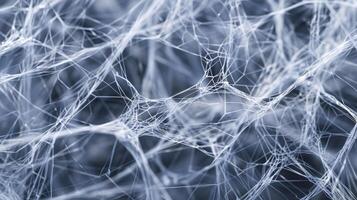
Fascia provides a support structure for our body and allows for the smooth gliding of muscles, tendons and ligaments. It is also, in the words of Dr Robert Schleip, ‘our richest sensory organ’. It is filled with nerve endings – encapsulated nerve endings for proprioception (telling us where our body is) and free nerve endings for introception (transmitting information about how we feel). According to Schleip 40% of the nerves of our sympathetic nervous system are in the fascia, which explains why it can become so tight and tense. Our fascia is alive and has its own innate intelligence.
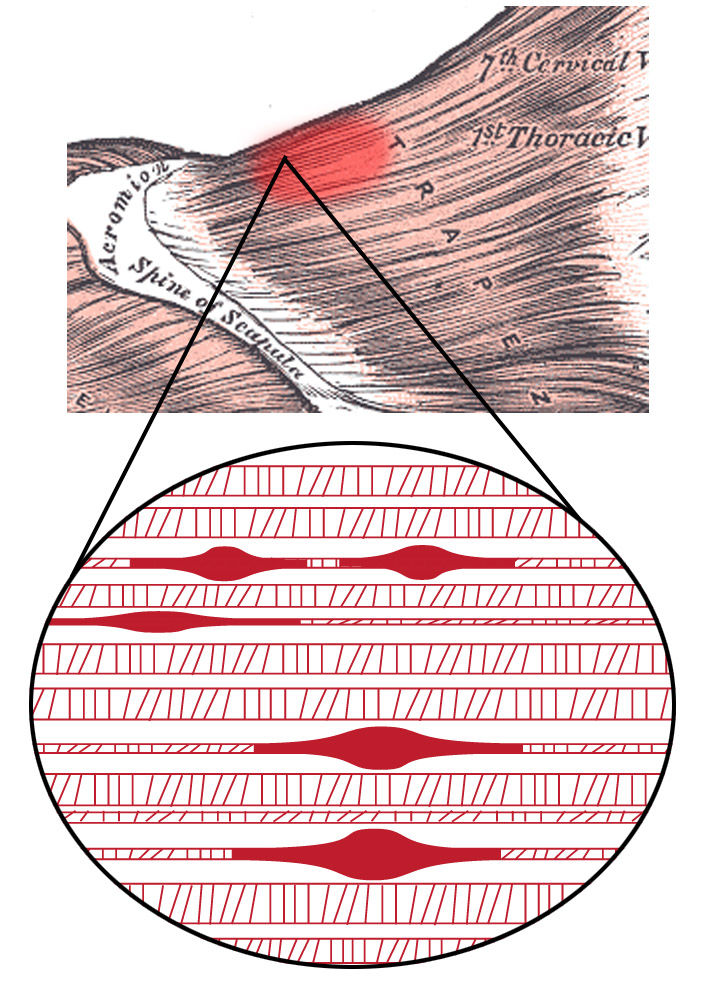
Myofascial knots are contracted areas in bands of muscle / fascia (remember they are interwoven) caused by overuse, injury and stress. They form irritable nodes where toxins build up and pain from them is often referred elsewhere. I didn’t get how pain could refer until I found out fascia is one continuous organ.
Trauma can be stored in the fascia if, after a traumatic event, there is no release. This can be for large traumas like accidents and severe injuries or smaller traumas like mine where I’ve felt a sudden pull and thought, “Oh shit.” The holding of trauma is often accompanied by holding the breath. Stress from work and relationships can also accumulate and be held in the fascia.
Finding this out helped to explain a number of my problems. I have runner’s knee in my left knee and deep gluteal syndrome in my left buttock. These two related problems come from having spent twenty years running on and off (with the off being due to these issues) without doing any strengthening. Since starting strength training at the gym they are greatly improved but have not gone away and I’ve realised that is because I’m still holding and moving my body in a certain way and this is due to trauma still held in my fascia.
Also, I’m prone to stiffness and knots in my neck and shoulders along with tightness in my jaw and squinty and achy eyes. These result from, like most Westerners, having spent most of my childhood and adult life hunched over a desk, squinting at words, under pressure to pass exams and meet deadlines.
Even though I’m now only a victim of my own deadlines I find it difficult to destress and to spend time away from my computer as the programming of society that I should be here, working, is so strong within me. And I’ve managed to eliminate social use, using my computer only for research and writing. I’m aware others spend many more hours on their laptops or phones.
All these pressures have accumulated in my fascia over the years and congealed into a structure I am concerned might take just as long to release!
As well as working with myofascial knots on the level of the physical body it is possible to work with them on the level of the energy body as well. Dr. Daniel Fenster provides evidence that over 90% of myofascial knots can be mapped onto accupuncture points and this is why accupuncture works so well. Accupuncture needles go deeper than the skin but not into muscle – into the fascia. This is where the meridians or nadis, river-like channels carrying chi or prana ‘vital life energy’ run. In yoga the energy body is called the prana-maya kosha ‘breath-filled sheath’ – it is associated with breath.
Whereas physiotherapists simply remove the knots some practitioners, such as Schleip, work with clients in a more holistic way that involves the use of breath and sound to release trauma that is held in the body. This makes complete sense because, if holding the breath played a role in the contraction causing the knots, then breathing out helps to undo them.
For much of my life I’ve existed in a constant sympathetic state in which I’ve been breathing in shallow into my chest exacerbarting panic and anxiety. For the past couple of years, since discovering yoga and polyvagal theory, I have been working to shift from a sympathetic to a parasympathetic state by slowing and deepening my breathing and extending my exhales. Trying to relax and breathe deeply in the gym, where I get overexcited if I’m doing well or tense up if I’m anxious about injury, is proving to be one of my biggest challenges.
As a shamanic practioner-in-training I am learning to feel and see blocked and congealed energies and to move them through vision, feel and breath. This new knowledge about how fascia relates to the energy body is something I intend to incorporate into my practice when healing myself and others.
One of the things I am learning from experience is that it’s no use doing energy work if I’m not also making changes in physical reality too. There’s no point removing congealed energy from the knot in my shoulder if I’m going to sit bent over my computer clicking on my mouse for several hours a day. Lifestyle changes to restructure my fascia for longevity.
SOURCES
Fenster, Daniel. Free Your Fascia: Relieve Pain, Boost Your Energy, Ease Anxiety and Depression, Lower Blood Pressure, and Melt Years Off Your Body with Fascia Therapy (Hay House, 2020)
Kusheva, Tatyana, ’Fascia – The Mysterious World Under Your Skin’ on Youtube, (Tatyana Kusheva, 2021)
Schelip, Robert, ‘The Bodywide Fascial Network’ on Youtube, (Inner Sense, 2021)
 The Sanctuary of Vindos