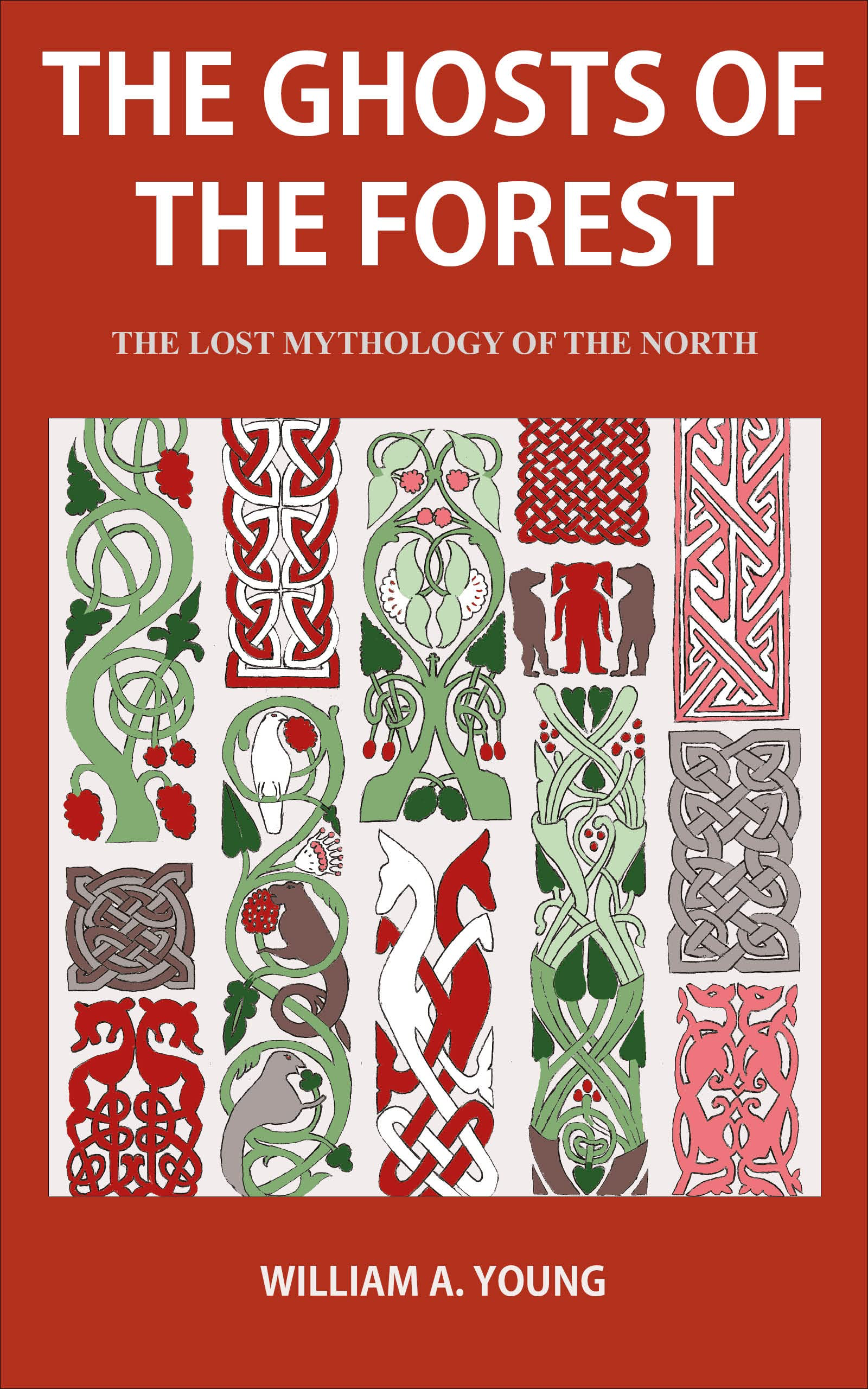
In The Ghosts of the Forest – The Lost Mythology of the North, Edinburgh-based writer William A. Young traces the folklore and legends of southern Scotland and the Borders and the figures within them back into the Brythonic past of Yr Hen Ogledd ‘The Old North’* and prehistoric Britain.
William follows a number of ghosts in literature and on foot, across the landscapes where the stories are set, to trace how they have arisen from the land – from a ‘Dreaming North’. He begins with Walter Scott and notes that his own collecting of the tales echoes Scott’s ‘raids’.
His first journey is to Eildon Hill, the Eildon Tree, and the Rhymer’s Stone. Here he finds connections between the legends of Cannabie Dick and Thomas the Rhymer and conjectures that the Fairy Queen might be linked to the Roman Diana, goddess of hunting and the wilds, to whom stood an altar less than 1km away.
He then journeys with the ghost of Myrthin* Wyllt the ‘surest guide’ to the lost world of the North’. This ‘wild Merlin of the Tweed’ and ‘madman’ is contrasted with ‘the Arthurian Merlin’ and ‘Archdruid’.
The quest to find Myrthin forms the heart of the journey. William begins with a visit to Myrthin’s grave in Drumelzier then follows William Skene and Nicolas Tolstoy in travelling to Arthuret, Liddel Strength and Caer Gwentholye where the tragic battle of Arfderyth took place and Myrthin went mad.
Like Tolstoy he makes links between the black mountain in Fergus and Myrthin’s Peak. These leads and the story of Owain take him not to Hart Fell but to the Bewcastle Fells and the complex of Glen Dhu (Black), Marven’s (Myrthin’s) Peak and Cleugh and Capelstone Fell.
William draws connections between the ‘Dark Man’ in Owain and the churl in Fergus. He identifies these figures with the Brythonic deity Cocidius who was worshipped at a shrine at Bewcastle known as Fanocodi. The spirit of the grove with whom Myrthin associates is tentatively identified with Nemetona, who is known as Diana Nemorensis under Intepretatio Romana. Owain’s links with the Brythonic deities Mabon and Modron and his father, Urien’s, with Nevyd, are also explicated. Here we find a potential ‘pantheon’ underlying these tales and this sacred landscape.
Cocidius is then further traced to legends featuring the ‘Brown Man of the Moors’ whose sacred home might have been the house-sized Kielder stone appearing in the legend of the ‘Colt of Kielder’. William then has a potent encounter with Cocidius ‘the Red God’ at his shrine at Yardstone where he comes ‘face to face’ with the God in a remarkable carving.
These journeys takes us into the heart of the Forest of Celython where Myrthin fled in his madness. William notes that here he finds not only plantation woodlands but, more encouragingly, areas of restoration such as Kielderhead Wildwood and areas owned by the Borders Forest Trust.
Suggestions based on William’s findings are finally made for further archaeolgical research.
This 606 page book is a labour of love crafted from poring over old texts and following them across the land, walking, camping, holding vigil in wild places, showing how by offering his ‘sweat’ and ‘time’ William has come closer to the old Gods. It gives voice to a quest and is the culmination of many years of dedication. I would recommend it to all who have an interest in the folklore and legends of Britain and how they might be traced to their prehistoric origins.
You can buy Ghosts of the Lost Forest HERE.
*William substitutes ‘th’ for the Welsh ‘dd’ in his spellings.
 The Sanctuary of Vindos
I have this book too! Very good and very well written, I quite like how he takes the reader on a journey to the actual places, allowing for connection between place and story.
Does anybody know where I might be able to buy a copy of this book – “The ghosts of the Forest”?
Any help would be very gratefully appreciated.
Regards
Stephen